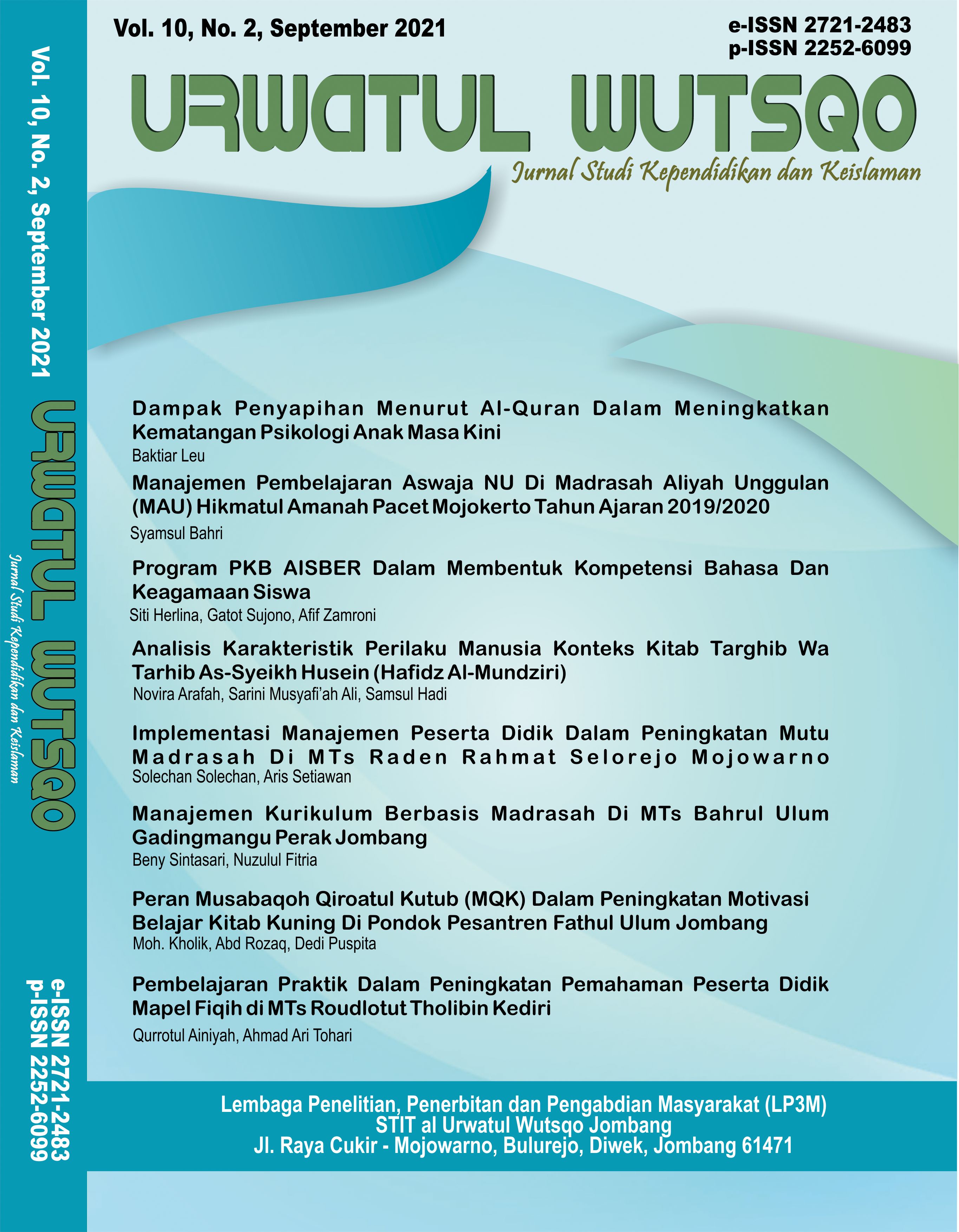
Analisis Karakteristik Perilaku Manusia Konteks Kitab Targhib Wa Tarhib As-Syeikh Husein (Hafidz Al-Mundziri)
DOI:
https://doi.org/10.54437/urwatulwutsqo.v10i2.284Keywords:
Characteristics, Human Behavior Context of the Targhib wa Tarhib As-Syeikh Husein’s book.Abstract
This study was conducted to describe and measure: (1) Characteristics of human behavior (2) Behavior based on the concept of the book Targhib wa Tarhib As-Syeikh Husein. The type of research used is descriptive qualitative is literature study. The results of this study indicate: (1) The characteristics of human behavior indicate a variety of human behavior. This diversity depends on how it is managed. In this case, of course, humans as the center of the center (2) Characteristics of human behavior in the context of Targhib wa Tarhib is to explain the Islamic concept of how behavior can refer to the direction of reward and punishment. Does something deserve appreciation or refers to the negligence that caused the punishment to be given. In this way, the Islamic concept also recognizes that praiseworthy behavior can be imitated, so that it is entitled to praise, praise and appreciation, while on the contrary, it is the same.
Downloads
References
Anggraini, Fina Surya. “Targhib Wa Tarhib Perspektif Al-Quran.” Jurnal Inovatif Vol 4, no. No.1 (2018): 141–65.
Assegaf, Rahman. Aliran Pemikiran Pendidikan Islam Hadharah Keilmuan Tokoh Klasik Sampai Modern. Jakarta: PT. Raja Grafindo, 2012.
Dedi Hantono. Diananta Pramitasari. “Diananta Pramitasari, Aspek Perilaku Manusia Sebagai Makhluk Individu Dan Sosial Pada Ruang Terbuka Publik.” Nature Vol. 5, no. No. 2 (2018): 85–93.
Dudung Abdurrahman.et al. “KARAKTERISTIK MANUSIA IDEAL DALAM PERSPEKTIF ISLAM.” Prosiding SNaPPSosial, Ekonomi, Dan Humaniora Vol. 5, no. No. 1 (2015): 487–94.
Iswati. “POLA PENERAPAN METODE TARGHIB WA TARHIB PADA PEMBELAJARAN TAHSIN TAHFIDZ DI SMPIT BINA INSANI KOTA METRO.” At-Tajdid Vol.2, no. No.2 (2018): 170–87.
Khotim, Nur Syafi’ah. Modul Starategi Pembelajaran. Yogyakarta: Bening Pustaka, 2019.
Kurniawan, Benny. “Konsep Targhib Dan Tarhib Dalam Perspektif Teori Belajar Behavioristik.” Institut Agama Islam Nahdlatul Ulama Kebumen?: An-Nidzam Vol. 03, no. No 1 (2016): 113.
Ma’rufin. “METODE TARGHIB DAN TARHIB (Reward Dan Punishment Dalam Pendidikan Islam).” Jurnal Risaalah, Vol . 1 , No. 1, Desember 2015 Vol. 1, no. No. 1 (2015): 67–77.
Mulyadi. “HAKIKAT MANUSIA DALAM PANDANGAN ISLAM.” Jurnal Al-Taujih Vol. 3, no. No. 1 (2017): 29–38.
Munawar Rahmat & M. Abdul Shomad. “Studi Model Pembelajaran Targhib Wa Tarhib Dalam Perkuliahan PAI Untuk Pembinaan Karakter Anti Korupsi Pada Mahasiswa.” JUrnal Pendidikan Agama Islam-Ta’lim Vol. 14, no. No.2 (2016): 127–38.
Muslimin. “Manusia Dan Karakteristiknya Menurut Al-Qur’an (Kajian Tafsir Tarbawi).” Jurnal Tribakti,Volume 27 Nomor 2 September 2016 Vol. 27, no. No. 2 (2016): 227–47.
Nurjan, Syarifan. Perilaku Delinkuensi Remaja Muslim. Yogyakarta: Samudra Biru (Anggota IKAPI), 2019.
Sejati, Sugeng. “Tinjauan Al Qur’an Terhadap Perilaku Manusia: Dalam Perspektif Psikologi Islam.” IAIN Bengkulu?: Syi’ar Vol. 2017, no. No. 1 (2017): 61–70.
Tjokroaminoto, HOS. Islam Dan Sosialisme. Bandung: Sega Arsy, 2010.
Tyas Palupi. Dian Ratna Sawitri. “Hubungan Antara Sikap Dengan Perilaku Pro-Lingkungan Ditinjau Dari Perspektif Theory Of Planned Behavior,.” Proceeding Biology Education Conference Vol. 14, no. No. 1 (2017): 214–17.
Undang-Undang Ri Nomor 20 Tahun 2003, Sitem Pendidikan Nasional, Pasal 3 Ayat 1, n.d.
Zulfikri Rahmat, Biki. “Corporate Social Responsibility Dalam Perspektif Etika Bisnis Islam.” Amwaluna: Jurnal Ekonomi Dan Keuangan Syariah Vol.1, no. No. 1 (2017): 98–113.
Downloads
Published
How to Cite
Issue
Section
License
Copyright (c) 2021 Novira Arafah, Sarini Musyafi’ah Ali, Syamsul Hadi

This work is licensed under a Creative Commons Attribution-ShareAlike 4.0 International License.