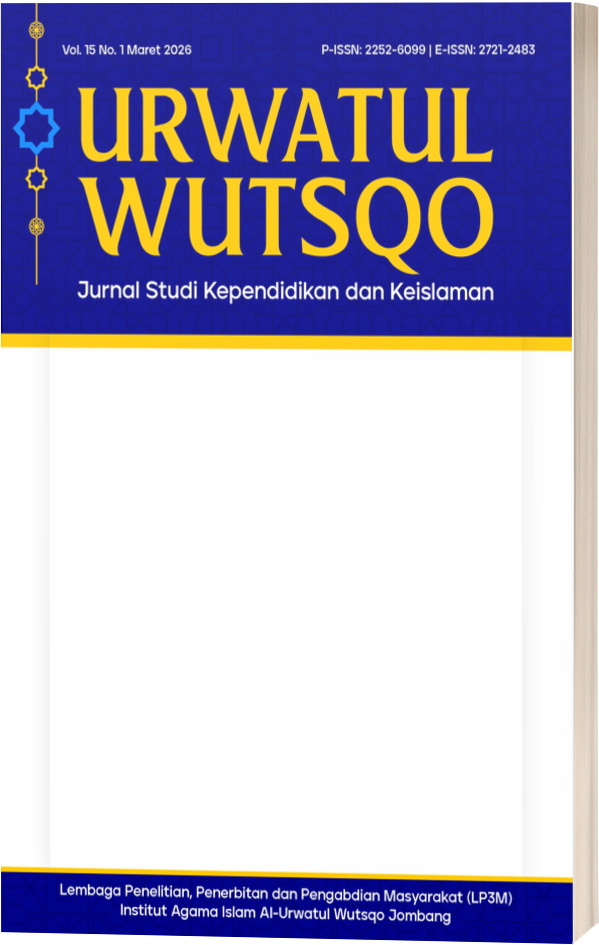
Inclusive Islamic Education Management: Strengthening Religious Moderation in Schools
DOI:
https://doi.org/10.54437/urwatulwutsqo.v15i01.2904Keywords:
Inclusive Education Management, Religious Moderation, Harmony Audit, Narrative Immunization, Transformative LeadershipAbstract
This study aims to analyze the strategy of inclusive Islamic education management in strengthening religious moderation in high schools in Banyuwangi Regency. Using a case study design, this study dissects the orchestration of the five pillars of management: curriculum, leadership, teacher competence, student engagement, and digital mitigation. The findings show that the transformative leadership of school principals is a determinant pillar or "heart" of the organization that synchronizes institutional policies with the local wisdom of "True Brotherhood". The main innovation of this research is the "Participatory Harmony-Based Inclusive Management" model, which introduces the Harmony Audit instrument for real-time detection of latent friction. The results of the intervention showed an increase in students' cognitive resilience scores by 32% and a 30% decrease in exposure to radical narratives through the "narrative immunization" strategy in digital literacy. In addition, the transformation of the teacher's dialogical pedagogy increased the effectiveness of class discussions by 40%, while the engineering of the extracurricular ecosystem successfully mitigated the phenomenon of "voluntary segregation". The theoretical implications confirm that the total integration of managerial authority, cultural intelligence, and digital mitigation is a systemic solution to create a cohesive and resilient school ecosystem in the era of information disruption
Downloads
References
Ainiyah, Q., Mirrota, D. D., & Khasanah, M. (2025). Religious Moderation: A Model for Internalizing Inclusive Islamic Values in Student Education. Urwatul Wutsqo: Jurnal Studi Kependidikan Dan Keislaman, 14(1), Article 1. https://doi.org/10.54437/urwatulwutsqo.v14i1.2031
Andini, D. R., & Sirozi, M. (2024). Integrasi Kearifan Lokal dalam Perencanaan Pengembangan Kurikulum Pendidikan Islam. Jurnal Inovasi, Evaluasi Dan Pengembangan Pembelajaran (JIEPP), 4(3), 465–471. https://doi.org/10.54371/jiepp.v4i3.566
Anwar, A. K., Yono, Y., Khumaedi, A., & Pramana, R. (2025). Meningkatkan Karakter Siswa dan Kearifan Lokal dengan Kurikulum Adaptif Berbasis Teknologi: Studi Kasus di SMP Al-Ikhlas, Astanajapura, Cirebon. Qomaruna, 3(1), 82–89. https://doi.org/10.62048/qjms.v3i1.112
Bartlett, T., & Yemini, M. (2025). Exploring extracurricular clubs in high schools as third spaces for developing youth activism and critical engagement. Journal of Research on Adolescence, 35(2), e70034. https://doi.org/10.1111/jora.70034
Bendl, R., Fleischmann, A., & Schmidt, A. (2024). Inclusion done differently? Representations of inclusion and exclusion in the discourse of alternative organizations. Organization, 31(1), 115–138. https://doi.org/10.1177/13505084221085902
Chen, C. (2026). The efficacy of targeted interventions in reducing implicit biases and promoting inclusivity in ideological and political education. International Journal of Inclusive Education, 1–19. https://doi.org/10.1080/13603116.2025.2598660
Dabutar, R. R., Nst, W. N., & Farabi, M. A. (2025). Religious Moderation as a Strategy for Student Competence Formation in Multicultural Schools. Academia Open, 10(2). https://doi.org/10.21070/acopen.10.2025.11582
Fairey, T. (2024). Peace is possible: The role of strategic narratives in peacebuilding. Media, War & Conflict, 17(1), 3–22. https://doi.org/10.1177/17506352231160360
Faridah, Z., & Rizqi, A. (2025). Dinamika dan Tantangan Penanaman Nilai-Nilai Moderasi Beragama dalam Konteks Pendidikan Agama Islam. Journal of Transdisciplinary Studies in Religion and Education, 1(1), 1–10. https://doi.org/10.63321/jtsre.v1i1.109
Harima, J., & Harima, A. (2025). Ecosystem leadership in catalyzing the emergence of entrepreneurial ecosystems: Social capital perspectives. International Journal of Entrepreneurial Behavior & Research, 31(5), 1381–1399. https://doi.org/10.1108/IJEBR-01-2024-0084
Hasan, M. S., Mujahidin, Azizah, M., & Solechan. (2024). Fostering A Moderate Attitude in Sufi-Based Pesantren Culture. At-Tadzkir: Islamic Education Journal, 3(2), Article 2. https://doi.org/10.59373/attadzkir.v3i2.66
Hasan, M. S., & Sintasari, B. (2025). Pengembangan Kurikulum PAI Berbasis Kurikulum Merdeka. Academia Publication.
Hidayat, R. N., Subhi, I., & Almukarromah, K. (2024). Strategi Kepala Sekolah dalam Mewujudkan Pembelajaran PAI yang Inklusif dan Berbasis Nilai. An-Nafah: Jurnal Pendidikan Dan Keislaman, 4(2), 92–105. https://doi.org/10.64469/an-nafah.v4i2.63
Kurniawan, A. F., Juhji, J., Mufrodi, M., & Sumintak, S. (2026). Strategic Management of Religious Moderation in Indonesian Higher Education: An Integrative Islamic Education Perspective. Kharisma: Jurnal Administrasi Dan Manajemen Pendidikan, 4(2), 260–271. https://doi.org/10.59373/kharisma.v4i2.100
Kuswahyuni, S. R., & Tejawiani, I. (2026). Systematic Curriculum Management and Teacher Performance Development: A Comparative Case Study in Rural Schools. Journal of Innovation and Research in Primary Education, 5(1), 227–238. https://doi.org/10.56916/jirpe.v5i1.2761
Lobo, C. A., Marinho, A., Santos Pereira, C., Azevedo, M., & Moreira, F. (2025). The Role of Leadership and Strategic Alliances in Innovation and Digital Transformation for Sustainable Entrepreneurial Ecosystems: A Comprehensive Analysis of the Existing Literature. Sustainability, 17(13), 6182. https://doi.org/10.3390/su17136182
Mazutis, D., Nubi, A., & Segal, E. (2026). Advancing Circularity: The Dynamic Capabilities to Drive Transformative Change. California Management Review, 68(2), 63–88. https://doi.org/10.1177/00081256251410909
Moh.Abdullah, Moh. A., Bello, R., & Nurfajriyani, N. (2026). Critical Pedagogy as Counter-Hegemony: Reorienting Islamic Religious Education Against Digital Radicalism and Disinformation. Surau Journal of Islamic Studies, 2(1), 48–71. https://doi.org/10.63919/surau.v2i1.62
Muhammad, A. E., & Liu, Y. (2025). Enhancing inclusivity in primary schools: The role of constructivist teacher education in addressing cultural diversity. Education 3-13, 1–20. https://doi.org/10.1080/03004279.2025.2475969
Muhammad Ilzamul Khoir & Suhulatul Amaliyah. (2025). Sinkronisasi Nilai Kearifan Lokal Pesantren: Standar Akreditasi Nasional. Paradigma: Jurnal Pemikiran Dan Penelitian Pendidikan, 11(2), 160–168. https://doi.org/10.64540/v6jsng54
Nisa, D., & Aimah, S. (2024). Strategic Adaptation in Islamic Education Quality Management: Navigating Social Developments for Sustainable Educational Outcomes. Journal of Educational Management Research, 3(2), 86–100. https://doi.org/10.61987/jemr.v3i2.427
Prabowo, G., Aimah, S., Algifari, M. F., & Fayoumi, Z. E. (2024). Evaluation of the implementation of quality management system to improve school accreditation in academic transformation. Electronic Journal of Education, Social Economics and Technology, 5(2), 50–57. https://doi.org/10.33122/ejeset.v5i2.176
Prado Ortega, M. X., Chamba Ojeda, S., Centeno Sandoval, M., Rueda Rodríguez, L. A., & Chamba Gómez, F. (2025). Learning Ecosystem: Designing an Inclusive Space to Enhance the Higher Education Process. International Journal of Changes in Education, 2(2), 104–114. https://doi.org/10.47852/bonviewIJCE52024054
Qusairi, M. (2026). Korelasi Korelasi Digital Religious Literacy dan Kemampuan Critical Thinking Mahasiswa PAI dalam Menangkal Radikalisme di Media Sosial. Jurnal Manajemen Dan Pendidikan Agama Islam, 4(1), 250–261. https://doi.org/10.61132/jmpai.v4i1.1779
Raihan, M. (2025). Memetakan Jaringan Transnasional Ideologi Keagamaan Di Kalangan Mahasiswa Pendidikan Islam. AN-NUR: Jurnal Pendidikan Dan Pembelajaran, 1(2), 197–210. https://doi.org/10.65802/an-nur.v1i2.45
Rendi Rendi, Grsia Monika Sinaga, & Samuel Linggi Topayung. (2024). Peran Pendidikan dalam Mengelola Keberagaman Masyarakat Multikutural di Indonesia. Jurnal Budi Pekerti Agama Kristen Dan Katolik, 2(3), 252–264. https://doi.org/10.61132/jbpakk.v2i3.684
Roucau, B., & Maxwell, B. (2025). Between maintaining teacher impartiality and protecting student dignity: Teachers’ responses to unacceptable student speech about politically sensitive issues in France and Quebec. Theory & Research in Social Education, 1–29. https://doi.org/10.1080/00933104.2025.2587148
Sabir Noor, Muhammad Zarif, Hina Mukhtar Ahmed, Ehsan Ullah Khadim, Saima Hasaan, Muhammad Amir, Muskan, & Nazia Zafar. (2025). Digital Education and Global Connectivity: Transforming International Relations in the 21st Century. Social Science Review Archives, 3(4), 2441–2455. https://doi.org/10.70670/sra.v3i4.1351
Saihu, S. (2019). Komunikasi Pendidik Terhadap Anak Berkebutuhan Khusus Di Sekolah Khusus Asy-Syifa Larangan. Andragogi: Jurnal Pendidikan Islam Dan Manajemen Pendidikan Islam, 1(3), 418–440. https://doi.org/10.36671/andragogi.v1i3.66
Sanya KENAPHOOM. (2024). The Role Of Digital Literacy In Shaping Education In The Next-Normal. Asian Education and Learning Review, 2, 29–41. https://doi.org/10.14456/AELR.2024.3
Tanjung, A. R., Amri, E., & Amelia, L. (2024). Strategi Sekolah dalam Mempertahankan Harmonisasi Sosial. Culture & Society: Journal Of Anthropological Research, 6(2), 89–102. https://doi.org/10.24036/csjar.v6i2.176
Tojiri, H. (2025). Strategies for Strengthening Integrated Religious Moderation Literacy in West Bandung Regency. Jurnal Ilmiah Gema Perencana, 4(1), 323–348. https://doi.org/10.61860/jigp.v4i1.82
Uzma Rafique, Anoosha Maryem, & Tanveer Fatima. (2025). Inclusive Education Through Informal School Spaces: Experiences of Students With Special Needs Beyond the Classroom in Pakistan. Social Science Review Archives, 3(4), 3918–3925. https://doi.org/10.70670/sra.v3i4.1505
Winarti, E., Astuti, N. D., & Nasukah, B. (2025). Sinergi Kepemimpinan Transformatif dan Etos Kerja Guru sebagai Determinan Hasil Belajar Siswa: Bukti Empirik pada Pendidikan Madrasah. Jurnal Multidisiplin Ibrahimy, 3(1), 63–82. https://doi.org/10.35316/jummy.v3i1.7884
Yu, Z. (2022). Sustaining Student Roles, Digital Literacy, Learning Achievements, and Motivation in Online Learning Environments during the COVID-19 Pandemic. Sustainability, 14(8), 4388. https://doi.org/10.3390/su14084388
Downloads
Published
How to Cite
Issue
Section
License
Copyright (c) 2026 Moh. Kholip Beril arrahman, Siti Aimah

This work is licensed under a Creative Commons Attribution-ShareAlike 4.0 International License.